WARDOGS Supply Runs: Turn a Request Into a Delivery the Team Can Use
A supply run needs a recipient, a useful destination and a way to confirm that the delivery solved the original problem. Organize those details before committing a vehicle or leaving an active position for a vague request.
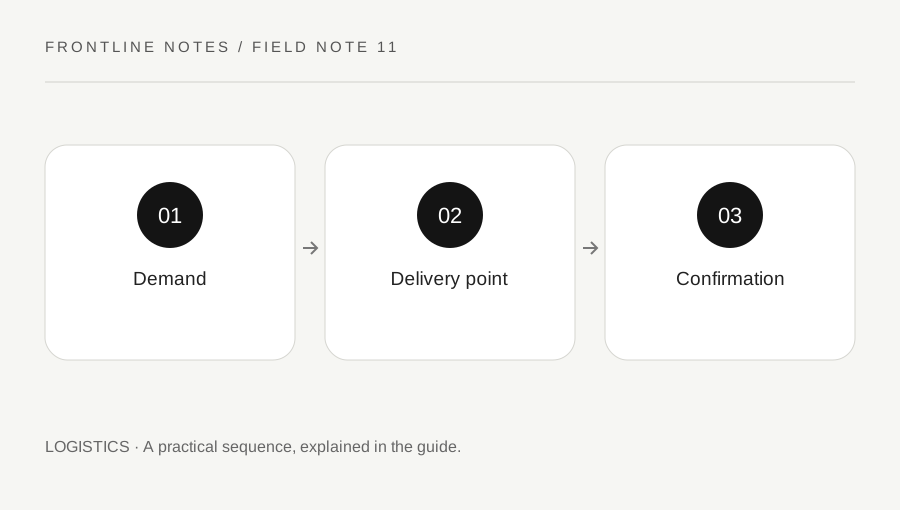
Original explanatory diagram. Examples illustrate a method or decision; they are not claims of personal testing.
Translate the request into a function
WARDOGS describes logistics and support alongside direct combat, including ferrying supplies to teammates. Start by establishing the missing function rather than assuming every request means the same cargo or trip. Ask who needs support, where they can receive it and whether the need will still exist when you arrive.
For example, a group holding an approach might request support because it cannot sustain its current action. The useful response begins with the actual requirement shown in the current game, not an invented universal supply package. Confirm the supported method before spending or loading anything.
Give the task a completion condition: the intended players can use what arrives, or the squad confirms that the need has moved. This prevents a successful journey from being mistaken for a successful delivery when the recipients are elsewhere or the item does not address the problem.
Choose the receiving point together
A convenient arrival point for the driver or pilot may be an inconvenient place for the receiving squad. Discuss where teammates can reach the delivery while retaining cover and awareness. A position immediately beside visible fighting may be easy to find but difficult to use.
Use a landmark, direction and fallback. "Rear side of the industrial building; use the next intact cover if that side is exposed" communicates more than "coming to you." Update the plan when destruction changes access or when another team appears on the approach.
Check whether the available vehicle and delivery method fit the location. This guide does not claim that every vehicle can carry every resource, land on every surface or perform the same interaction. Inspect the current supported controls and choose within those limits. If a safe and usable receiving point cannot be agreed, say so before the trip becomes an expensive search for moving teammates.
Avoid turning the run into an unrelated mission
A logistics route can accumulate distractions: a visible enemy, a tempting position or another request. Reassess rather than automatically extending the trip. Every detour changes the time and risk of meeting the original demand.
Suppose your recipients begin moving toward a different part of the Control Zone while you are approaching. Ask whether to redirect, meet at the next useful location or cancel the delivery. Continuing to the old point because it was agreed earlier creates a correct execution of an outdated plan.
Keep travel communication brief. A recipient needs arrival status and a meaningful delay, not every detail of the route. Conversely, tell the provider when the need disappears. The ability to cancel a run cleanly is part of efficient logistics. It preserves attention and resources that can be assigned to another supported team action rather than forcing a delivery that no one currently wants.
Close the loop and inspect the bottleneck
Confirm arrival and whether the intended recipient can actually use the support. If the delivery method requires an interaction, the receiving player should verify it through the current game interface. Do not assume that dropping something nearby is enough or that an animation proves the recipient obtained the intended benefit.
Afterward, distinguish transport failure from demand failure. Was the route compromised? Was the delivery point exposed? Did the request identify the wrong resource? Had the team moved before the run began? Each answer suggests a different improvement.
For the next run, change one part: a clearer request, a receiving point with better access or an earlier cancellation call. Do not evaluate logistics only through personal cash changes or the spectacle of a vehicle arriving under fire. A strong run gives teammates a capability they actually need at a location and time when they can use it, while keeping the provider connected to the match's current objective.
A practical checklist
Choices are saved in this browser. Reset them here or clear this site’s browser storage.
Questions that come up
Does every request justify buying a vehicle?
No. Compare the actual task with available supported options and what the squad can use when you arrive.
Is reaching the landmark the completion condition?
Only if the intended players can use the support there. Confirm receipt or the relevant in-game effect.
Does this page specify cargo capacity?
No. Inspect the current vehicle and interaction rules rather than applying an assumed universal capacity.
References & scope
Background references checked on 18 October 2026. Worked examples and diagrams are original teaching material.