WARDOGS Fortification Planning: Build a Position That Still Works When Used
A fortification should solve a particular battlefield problem. Plan its view, access and fallback before investing attention in construction, then check whether teammates can actually use the result under the current Control Zone conditions.
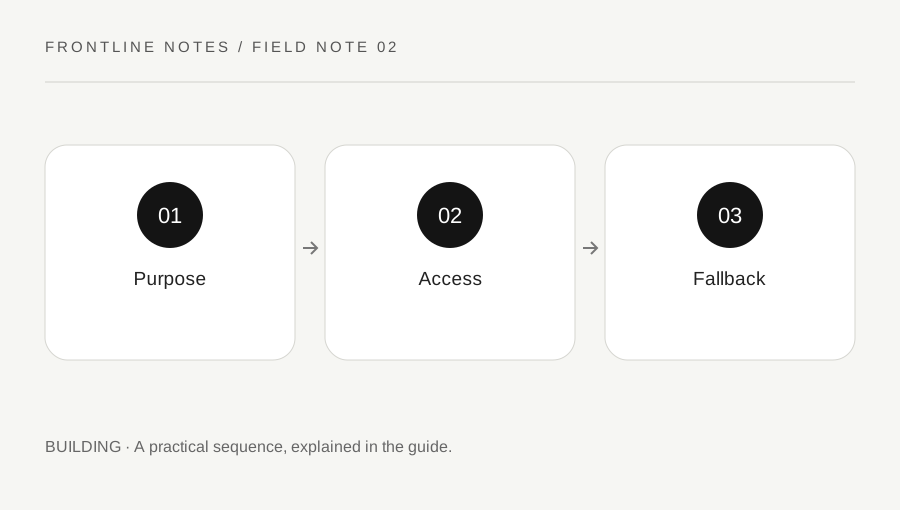
Original explanatory diagram. Examples illustrate a method or decision; they are not claims of personal testing.
Start with the job, not the shape
The official WARDOGS overview includes building and fortifying positions within a destructible battlefield. It does not make every constructed position useful. Before building, describe a single job: protect a crossing, support a nearby approach or offer a place from which teammates can contribute to the objective.
Translate that job into a question you can answer on site. Can a teammate reach the position from the current approach? Does it face something the team needs to observe? Can a player leave when the pressure changes? If those questions have no clear answers, construction may be creating an attractive landmark rather than solving a problem.
For example, a defended corner near an active approach can be more useful than an elaborate structure behind terrain that blocks every relevant view. Choose the function first, then inspect the construction options actually available in the current game. This guide does not prescribe an unverified recipe or blueprint.
Walk the teammate journey
Imagine arriving as a teammate who did not watch you build. Follow the route into the position, find the place where the intended job happens, and identify the way out. A narrow or confusing approach can turn a theoretically strong location into a place nobody can use quickly.
Check whether access requires crossing an exposed lane. If it does, tell the squad before they commit, and reconsider whether another location offers a better balance. Protection at the destination does not erase the danger of reaching it.
Leave room for the current movement and equipment that the position is supposed to support. Do not claim that a particular opening fits every vehicle or that every built element blocks the same threats. Observe what the actual interface and geometry allow. Ask one teammate to describe the entrance in ordinary words; if the call is confusing, improve the plan or the call.
Design for the terrain changing
WARDOGS combines construction with destruction. Treat the surrounding buildings and cover as conditions that can change, not permanent guarantees. Identify which part of the position stops working if an adjacent wall disappears or an enemy gains a different view.
Consider a position intended to protect a street crossing. If a nearby building is destroyed, players using it may become visible from a second direction. A fallback behind intact terrain should be identified before that happens, rather than discovered while everyone is already exposed.
Do not make the fallback identical to the entry if a single enemy angle can cover both. When the available terrain permits only one route, communicate the limitation clearly. A modest position with a known weakness can still serve a temporary purpose; the mistake is presenting it as an all-purpose secure base. Recheck the sightlines after nearby destruction instead of trusting the original layout.
Measure use and decide when to leave
Once the position exists, observe whether it improves the intended action. Are teammates crossing with less confusion? Can the squad see the approach it wanted to monitor? Is the position still relevant to the current Control Zone? These questions are more useful than counting the amount built.
If the objective or fighting moves, compare maintaining the position with reaching the next useful location. Prior effort is not a reason to remain disconnected from the match. Tell teammates whether the position remains available, has become compromised or is being abandoned.
In the review, record the function, one access problem and one exposure that developed. Keep screenshots free of personal information if sharing them. The next improvement might be a simpler entrance, a different location or no construction at all under similar conditions. Successful fortification is measured by the team action it enables, including the ability to stop using it before its disadvantages outweigh its purpose.
A practical checklist
Choices are saved in this browser. Reset them here or clear this site’s browser storage.
Questions that come up
Does this guide provide a building recipe?
No. Use the current construction interface for supported parts and requirements. This page explains how to evaluate the resulting position.
Should a position be maintained because it was expensive?
Past effort cannot make an irrelevant location useful. Compare its present function with what the team needs next.
Can fortifications guarantee safety?
No. Geometry, enemy pressure and destruction can change the risks. Keep observing and preserve a fallback.
References & scope
Background references checked on 18 October 2026. Worked examples and diagrams are original teaching material.