WARDOGS Updates: Separate Available Features, Announced Plans and Your Next Session
WARDOGS is evolving during Early Access. Read official updates as dated information, distinguish a development plan from a released feature and turn a relevant change into one practical question for your next supported session.
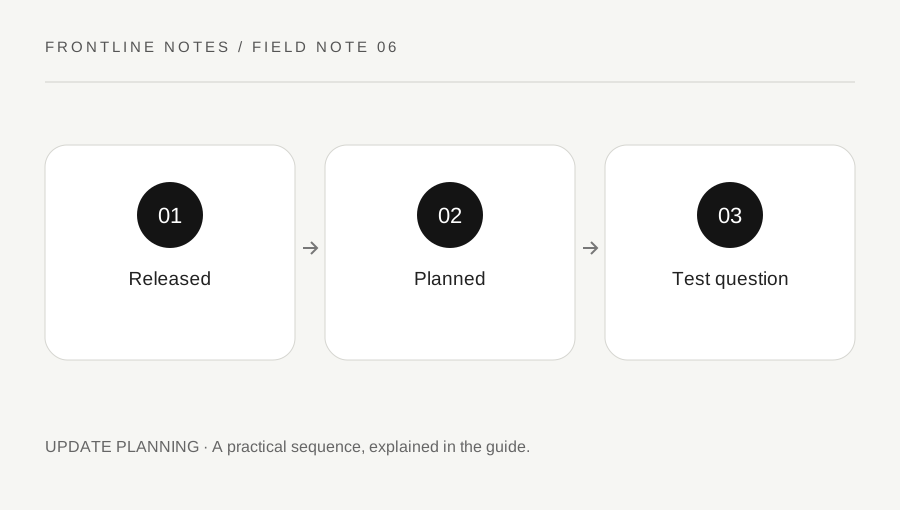
Original explanatory diagram. Examples illustrate a method or decision; they are not claims of personal testing.
Start with the current official status
The official store and publisher pages describe WARDOGS as an Early Access game. Use those current sources and the developer's linked announcements to establish what is available, rather than assuming a preview video or an old discussion describes today's client.
Keep the date and source beside an update note. A statement can be accurate for the build it described and still be unhelpful after later changes. Avoid copying an undated list into a permanent checklist that gives no way to identify its context.
For example, the developer's Early Access description discusses future expansion as a plan. A planned vehicle category is not proof that it can be selected now. Before organizing a session around a feature, look for an explicit release announcement and confirm the supported option in the current game. This simple distinction prevents wasted preparation and misleading instructions for friends.
Translate the change into an affected task
Read what the announcement changes and connect it to an action you already perform. A control adjustment may affect your setup check; a building change may affect a position you use; a progression change may affect the information you review before spending.
Avoid turning every update into a complete rebuild of your routine. Identify which current assumption the new information challenges. If it does not affect your planned session, keep a short note and continue with your existing goal.
Suppose an official update changes the behavior of an interaction relevant to a supply run. Your next question might be whether the receiving player can use the delivery as before. That is more useful than declaring the whole logistics system transformed without checking it. Use the exact wording of the current announcement for factual limits, and keep your proposed experiment clearly separate from what the developer has confirmed.
Compare one ordinary scenario
Choose a supported situation where the changed behavior can be observed without disrupting other players. Keep the baseline in mind and note the relevant equipment, location and match context. If several systems changed at once, avoid assigning every different outcome to the one feature you were watching.
For instance, a previously useful position may feel weaker because nearby terrain changed during the match, because another team approached differently or because a released adjustment affects the interaction. Record what you actually saw before deciding which explanation fits.
Do not use exploits, modified files or automated inputs to force a comparison. BULKHEAD's enforcement requirements continue to apply during experimentation. A short ordinary-play observation with clear limits is more valuable than an apparently precise result produced through unsupported methods. If the observation conflicts with the announcement, preserve the details and consider whether a focused support report is appropriate.
Update the habit, not just the opinion
After checking the relevant scenario, decide whether a practical habit should change. This may mean rechecking a control, confirming an interaction before committing resources or choosing a different fallback when a structure changes. Keep the adjustment small enough to use consistently.
Retain uncertainty when the evidence is incomplete. "Observed once after this update" is different from "always works this way." A future official clarification or a more representative match may change your understanding.
When sharing a guide with teammates, include the dated official source and the question you tested. Remove claims that a planned feature is already present, and retire old instructions when they no longer match the interface. The result is a living preparation routine rather than a collection of confident predictions. Early Access requires attention to current behavior, but careful source reading can make that attention efficient and prevent every announcement from turning into unnecessary spending, reinstalling or relearning unrelated parts of the game.
A practical checklist
Choices are saved in this browser. Reset them here or clear this site’s browser storage.
Questions that come up
Does a roadmap entry mean a feature is usable now?
No. Look for a release announcement and confirm the current supported interface before planning around it.
Should every update change my entire setup?
No. Identify the tasks affected by confirmed changes and adjust the relevant habit.
Does one test establish universal behavior?
No. Record the scenario and limits, then revise the conclusion when better evidence or official clarification appears.
References & scope
Background references checked on 18 October 2026. Worked examples and diagrams are original teaching material.